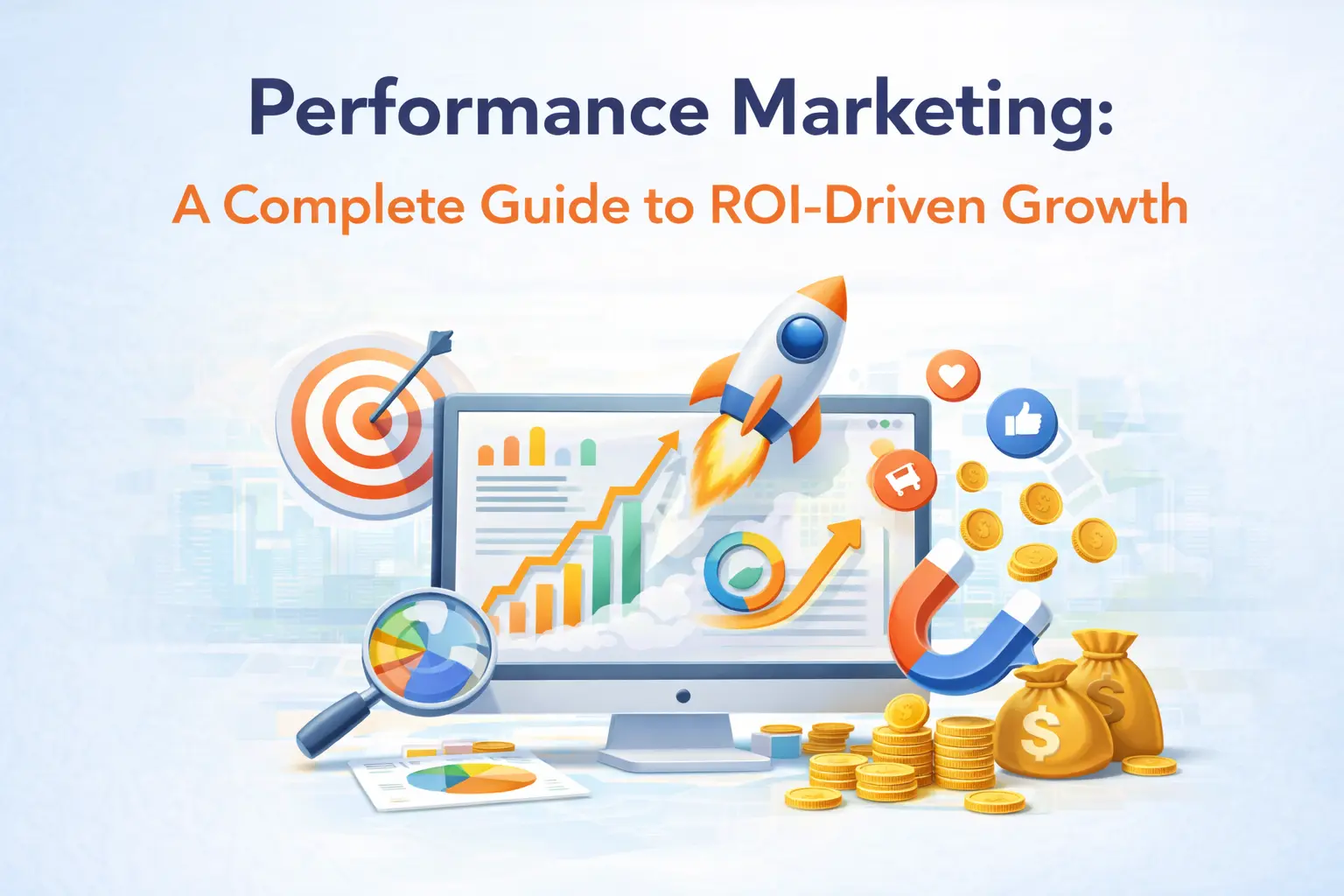
Performance Marketing: A Complete Guide to ROI-Driven Growth
Table of Contents
Traditional marketing asks you to spend money and hope for results. Performance marketing flips that equation—you only pay when specific actions happen. Whether that’s a click, a lead, or a sale, you know exactly what you’re getting for your money. This approach has transformed how businesses grow online, letting even small companies compete with big budgets by focusing ruthlessly on what actually works.
What Is Performance Marketing?
Performance marketing means paying for results, not promises. Instead of paying for a billboard and hoping people see it, you pay when someone actually clicks your ad, fills out a form, or buys your product. Every dollar spent connects directly to a measurable action.
This results-first approach changes everything. Bad campaigns die quickly because they don’t generate results. Good campaigns get more budget because they’re proving their value in real-time. You’re not guessing what works—you’re watching the data tell you.
The Core Channels That Drive Results
Performance marketing happens across multiple platforms, each with unique strengths. Understanding where and how to reach your customers determines your success. Some of the most commonly used channels are:
- Paid search puts your ads in front of people actively searching for what you sell. When someone searches “running shoes for flat feet,” they’re ready to buy—paid search captures that intent. Google Ads dominates here, but don’t sleep on Bing Ads for lower costs and less competition.
- Paid social reaches people based on who they are and what they like, not what they’re searching for. Facebook, Instagram, LinkedIn, and TikTok let you target incredibly specific audiences. Someone interested in marathon running, lives in Denver, and just got engaged? You can reach them with ads for running gear as wedding gifts.
- Display advertising shows visual ads across millions of websites. While less targeted than search or social, display reaches massive audiences and works well for retargeting people who visited your site but didn’t convert.
- Affiliate marketing lets other people promote your products for a commission on sales they generate. You only pay when they deliver results, making it pure performance marketing. The challenge is finding quality affiliates who represent your brand well.
- Native advertising blends promotional content into the natural flow of websites and apps. Done well, native ads don’t feel like ads—they provide value while driving actions.
Understanding Your Performance Marketing Funnel
Not everyone who sees your ad is ready to buy immediately. Most people need multiple touchpoints before converting. Your funnel represents this journey from stranger to customer.
- Top of funnel (awareness) introduces your brand to people who don’t know you yet. These campaigns cast a wide net, reaching cold audiences with content that educates or entertains. Success here isn’t immediate sales—it’s getting attention from the right people.
- Middle of funnel (consideration) nurtures people who’ve shown interest. Maybe they visited your site, watched a video, or engaged with your content. These campaigns provide more detailed information, address objections, and build trust.
- Bottom of funnel (conversion) targets people ready to buy. They’ve done research, they know what they want, and they’re comparing options. These campaigns need strong offers, clear calls-to-action, and an easy path to purchase.
For a detailed breakdown of building funnels that convert cold traffic into paying customers, check out our guide on How to Build a Performance Marketing Funnel.
Setting Up for Success: The Foundation
Before running any campaigns, get your foundation right. Skipping this setup costs you money through missed conversions and bad data.
- Tracking and analytics are non-negotiable. Install conversion tracking on your website so you know which campaigns drive actual results. Set up Google Analytics and connect it to your ad platforms. Track not just purchases but also smaller actions—email signups, phone calls, form submissions—that indicate progress toward sales.
- Landing pages make or break campaign performance. Sending ad traffic to your homepage rarely works well. Create dedicated landing pages that match your ad message, have one clear goal, and eliminate distractions. The tighter the connection between ad and landing page, the better your conversion rate.
- Conversion optimization (CRO) shouldn’t wait until after launching campaigns. Before spending on traffic, make sure your site converts visitors efficiently. For deep-dive tactics on turning more visitors into customers, read our comprehensive guide on Conversion Rate Optimization Best Practices.
The Metrics That Actually Matter
Performance marketing generates tons of data. Focus on metrics that directly connect to business results, not vanity numbers that look good but don’t help.
Return on ad spend (ROAS) tells you how much revenue each ad dollar generates. Spend $1,000 and generate $3,000 in sales? That’s 3:1 ROAS. This metric directly shows profitability and helps you decide where to invest more budget.
Cost per acquisition (CPA) shows what you pay to get a customer or lead. If your average customer is worth $500 and your CPA is $100, you’re in good shape. If your CPA is $600, you’re losing money on every customer.
Customer lifetime value (LTV) reveals what customers are worth over time, not just their first purchase. If customers typically buy three times and spend $200 each time, their LTV is $600. This bigger picture justifies higher acquisition costs for customers who stay longer.
Conversion rate (CR) shows what percentage of visitors take your desired action. Get 1,000 visitors and 20 sales? That’s a 2% conversion rate. Improving this number directly boosts profitability without needing more traffic.
Optimizing for Better Performance
Launching campaigns is just the beginning. Continuous optimization separates profitable campaigns from money pits. Follow the below actions to acheive maximum optimzation score:
- Start with learning before chasing immediate profits. Give new campaigns time and budget to gather data—usually $500-1,000 and 7-14 days minimum. Platforms need this learning phase to understand what works.
- Analyze what the data tells you. Which audiences convert best? Which ad creatives get attention? Which landing pages seal the deal? Double down on what’s working and cut what’s not.
- Make incremental changes, not huge overhauls. Change one thing at a time so you know what actually improved performance. Changing everything at once when something goes wrong is like throwing darts blindfolded—you might hit something, but you won’t know why.
- Scaling smart means knowing when to grow and how fast. Found a winning campaign? Great! But don’t 10x your budget overnight—that often kills what made it work. Gradual increases (20-30% weekly) let platforms adjust and maintain efficiency.
For proven strategies on growing your ad spend while maintaining profitability, read our detailed guide on Ways to Scale Ad Campaigns Without Killing ROAS.
Retargeting: Your Secret Weapon
Retargeting shows ads to people who already visited your site or engaged with your content. They know who you are, so you can skip the introduction and address what’s holding them back. Maybe they need a discount, more information, or just a reminder that you exist.
Segment your retargeting based on behavior. Someone who viewed a product needs different messaging than someone who abandoned their cart. Cart abandoners are hot leads—they were seconds from buying. Show them a small discount or free shipping to close the deal.
Control how often people see your ads. Showing the same ad 20 times in a day annoys people. Cap frequency at 3-5 times daily maximum to stay visible without becoming obnoxious.
Use time windows strategically. Recent visitors (last 7 days) get aggressive campaigns with strong offers. Older visitors (30+ days) get softer brand awareness content since they’re further from purchase.
For comprehensive strategies on winning back visitors who didn’t convert the first time, check out our guide on Retargeting Strategies That Actually Work.
Common Mistakes That Kill Performance
Even experienced marketers make these errors. Avoid them to save money and frustration.
- Optimizing for the wrong goals. Getting lots of clicks feels good, but if those clicks don’t convert, you’re wasting money. Always optimize for actions that generate revenue, not vanity metrics.
- Giving up too early. New campaigns need time to work. Killing them after two days and $100 spent doesn’t give platforms enough data to optimize. Be patient through the learning phase.
- Ignoring mobile users. More than half your traffic probably comes from phones. If your site looks terrible or loads slowly on mobile, you’re throwing away potential customers.
- Spreading budget too thin. Running 20 small campaigns usually performs worse than running 5 well-funded ones. Consolidate your efforts where you can make real impact.
- Not testing enough. Your first attempt is rarely your best. Successful performance marketers constantly test new audiences, creative, offers, and landing pages to find improvements.
Building Your Performance Marketing Strategy
Success doesn’t come from random tactics—it comes from strategic planning executed consistently.
- Start with clear goals. How many customers do you need? What’s an acceptable acquisition cost? What ROAS makes your business work? Define these numbers before spending anything.
- Choose your channels wisely. You can’t do everything well with limited resources. Pick 1-2 channels where your customers actually spend time and focus your energy there.
- Create a testing calendar. What will you test each week? New audiences? Different ad creative? Landing page variations? Plan your tests so you’re always learning and improving.
- Build processes, not just campaigns. Document what works so you can repeat it. Create templates for winning ad formats. Establish workflows that let you launch and optimize consistently.
- Review and adjust regularly. Set weekly time to review performance, identify trends, and make decisions about budget allocation. The most successful marketers stay close to their data and respond quickly to what they see.
Final Thoughts
Performance marketing transforms how you grow your business by connecting every dollar spent to measurable results. Instead of hoping your marketing works, you know it works because you can track exactly what happens with each investment.
Success in performance marketing isn’t about one brilliant campaign. It’s about systematic improvement over time. Start this week with one campaign focused on one clear goal. Track it properly, optimize based on data, and build from there. Each win teaches you something that makes the next campaign better.
Ready to build performance marketing programs that consistently deliver profitable growth? Get expert guidance on strategies, execution, and optimization that turn ad spend into predictable revenue.