
Table of Contents
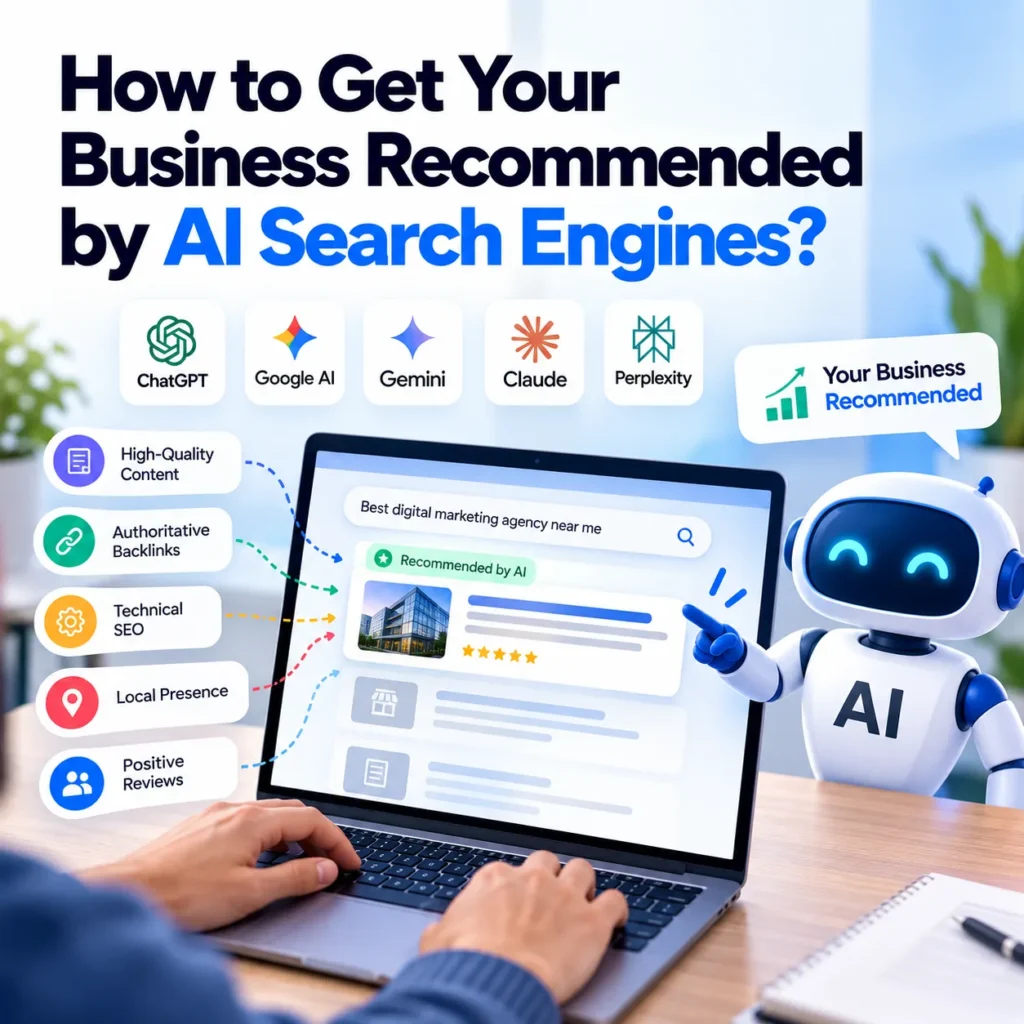
Think about the last time you asked an AI tool something like “best accountant near me” or “which moving company should I use.” Chances are you got a short list of names with a quick reason for each one, not a page of blue links to sort through yourself. That’s the shift happening right now. People are starting to trust AI tools to do the shortlisting for them, which means the real competition isn’t just to rank anymore, it’s to be the business the AI actually mentions by name.
This matters more than it might seem at first. If an AI tool recommends three competitors and skips you entirely, you never even get the chance to make your case. The good news is that getting recommended isn’t random. These tools lean on patterns and signals you can actually influence, and most businesses haven’t touched any of them yet.
How AI tools actually decide who to recommend
AI search engines and assistants don’t have personal opinions about your business. They’re pulling from a mix of sources: your Google Business Profile, how consistently your business information appears across the web, your reviews, structured data on your site, and how often other reputable sources mention or link to you. When a model has to recommend a handful of businesses out of thousands, it leans toward the ones it can describe with the most confidence. Confidence comes from consistency and clear, verifiable information, not clever marketing copy.
Signals AI search engines tend to weigh
| Signal | Why it matters |
| Google Business Profile | Often the single most trusted source of basic facts about a local business |
| Review volume and quality | Signals real world trust and recent activity, not just existence |
| Consistent name, address, phone | Mismatched details across the web make a business look unreliable |
| Structured data and schema | Makes it easy for AI models to extract accurate facts automatically |
| Third party mentions | Being mentioned on other trusted sites adds credibility beyond your own claims |
| Clear, specific content | Vague descriptions are harder for a model to confidently recommend |
Start with your Google Business Profile
If there’s one place to focus first, it’s this. Your Google Business Profile is one of the most heavily referenced sources when AI tools are putting together local recommendations. An incomplete profile, outdated hours, or a category that doesn’t quite match what you actually do can quietly knock you out of consideration before anything else even gets evaluated.
We put together a full breakdown on Google Business Profile optimization that covers the details most businesses overlook, from choosing the right categories to keeping your information current. It’s worth going through line by line, since small gaps here tend to have an outsized effect on whether you get recommended at all.
Keep your business information consistent everywhere
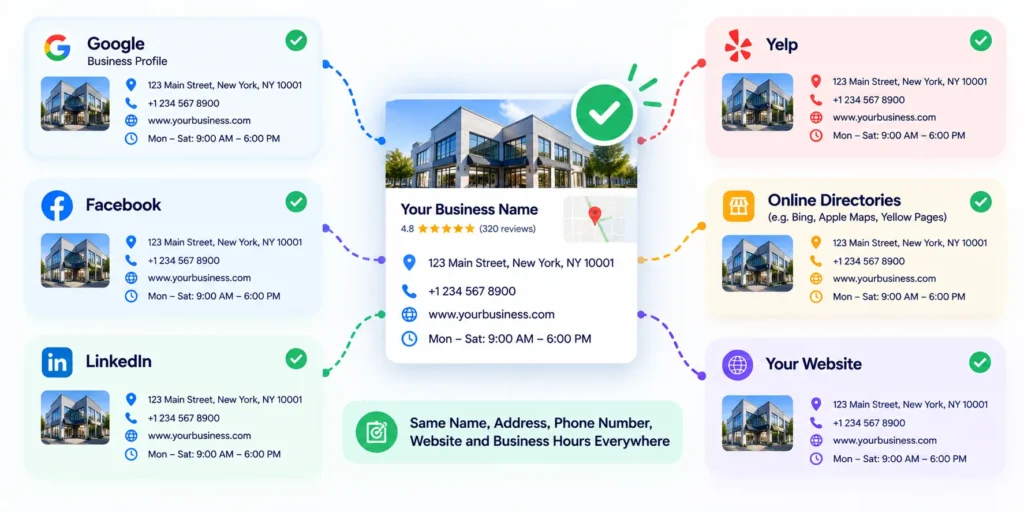
This one sounds basic, but it trips up more businesses than you’d expect. If your business name, address, or phone number is slightly different on your website, your Google listing, your Facebook page, and a directory site from years ago, that inconsistency makes it harder for any system, AI or otherwise, to confidently confirm who you are and where you operate. Go through your major listings every so often and fix anything that doesn’t match exactly.
Build reviews that actually say something
A pile of five star ratings with no written detail doesn’t give an AI model much to work with. Reviews that mention specific services, specific outcomes, or specific reasons someone chose your business give these tools actual language to pull from when deciding how to describe you. Encourage happy customers to mention what they came in for and how it went, rather than just leaving a star rating and nothing else.
- Ask for reviews shortly after a good experience, while it’s still fresh
- Respond to reviews, including the negative ones, in a way that’s calm and specific
- Avoid review templates that make every review sound identical
- Keep an eye on review volume over time, not just your average rating
Make your website easy for AI models to understand
Your website still matters a lot here. Pages that clearly explain what you do, who you serve, and where you operate give AI tools something concrete to summarize. Vague taglines and stock phrases like “your trusted partner for all your needs” don’t tell a model anything useful. Be specific about your services, your location, and what makes your approach different, written the way you’d explain it to a person standing in front of you.
Structured data, sometimes called schema markup, also plays a bigger role here than most business owners realize. It’s a behind the scenes way of labeling information on your site, like your business type, hours, and services, so machines can read it accurately instead of guessing. If your site doesn’t have this set up, it’s one of the more technical but genuinely worthwhile fixes available.
Get mentioned by other trusted sources
AI tools weigh outside validation heavily. A business that only talks about itself on its own website looks very different from one that’s mentioned in local news, industry directories, guest posts, or roundups put together by other trusted sites. This doesn’t mean chasing links from anywhere that will have you. A handful of mentions from genuinely relevant, respected sources does more for your credibility than a long list of low quality ones.
Answer the questions people are actually asking
A lot of businesses write content around what they want to say about themselves instead of what potential customers are actually asking. Think about the real questions people type or speak before they need a business like yours: how much something costs, how long it takes, whether you serve a specific area, what makes you different from the obvious competitor down the street. Content that answers these directly is far more likely to get pulled into an AI generated answer than a generic about page.
Check how you’re currently showing up
Every so often, ask an AI tool the kinds of questions a potential customer might ask about businesses like yours. See who gets mentioned, who doesn’t, and what language is used to describe the businesses that do come up. You won’t get a perfect picture, since answers can vary, but doing this regularly gives you a real sense of where you stand and whether your efforts are actually moving the needle.
When it’s worth bringing in help
Between your Google Business Profile, your website content, structured data, reviews, and outside mentions, there’s a lot to manage at once, and most of it needs ongoing attention rather than a one time fix. If you’re already stretched thin running the business itself, it often makes more sense to have a dedicated team handle this consistently instead of chipping away at it occasionally. Our
SEO services are built to cover exactly this kind of work, from the technical groundwork to the ongoing visibility tracking, so your business has a real shot at being the one AI tools actually recommend, not just another listing buried somewhere in the results.
The bottom line
Getting recommended by AI search engines isn’t about gaming a system, it’s about making sure accurate, consistent, well supported information about your business is easy to find everywhere these tools look. Start with your Google Business Profile, clean up inconsistencies across the web, build reviews with real substance, and make sure your website answers real questions clearly. None of this happens overnight, but businesses that put in this groundwork now are the ones quietly showing up in recommendations while everyone else wonders why they got left out.
Leave a Reply