

Table of Contents
A few years ago, ranking well meant showing up on the first page of Google. Now people are asking ChatGPT, Perplexity, and Google’s AI overviews the same questions they used to type into a search bar, and these tools are pulling answers directly from websites instead of just listing links. If your site isn’t showing up in those answers, you are missing out on a growing chunk of visibility, even if your regular search rankings still look fine.
What AI search actually means for your website
AI search tools work differently from traditional search engines. Instead of just matching keywords, they read and summarize content to answer a question directly. That means your site doesn’t just need to rank, it needs to be clear enough and well structured enough for an AI model to understand what you’re saying and confidently use it as a source.
The good news is that most of what helps with AI search also helps with regular SEO. You’re not starting from zero or learning a completely new skill. You’re mostly tightening things up and being more deliberate about clarity and structure.
Traditional SEO vs AI search optimization
| Area | Traditional SEO Focus | AI Search Focus |
| Goal | Rank high in search results | Get quoted or summarized directly in an answer |
| Content style | Keyword focused, longer pages | Clear, direct answers near the top of the page |
| Structure | Helpful but not always required | Headings, lists, and schema matter a lot more |
| Trust signals | Backlinks and domain authority | Clear sourcing, author credibility, and factual accuracy |
Make sure AI tools can actually read your site first
Before worrying about how to write for AI search, it helps to confirm there’s nothing stopping these tools from accessing your pages in the first place. AI crawlers run into the same problems regular search engine bots do: blocked pages, broken internal links, pages that never get indexed, or a site structure that’s just confusing to crawl. None of the writing advice in the world helps if the page never gets read to begin with.
If you haven’t checked on this in a while, it’s worth going through our breakdown of common crawling and indexing issues and fixes to rule out anything technical that might be quietly keeping your pages out of reach.
Write content that answers the question directly
AI tools tend to pull from content that gets to the point quickly. If someone asks a question and your page buries the answer under three paragraphs of introduction, there’s a good chance the AI model skips your page for a competitor’s that answered it in the first sentence.
A simple habit that helps a lot: write the direct answer to the main question near the top of the page, then use the rest of the content to explain, support, or add context. You’re not writing for a search engine scanning keywords anymore. You’re writing for a system trying to extract a clear, usable answer.
Structure your pages so they’re easy to break down
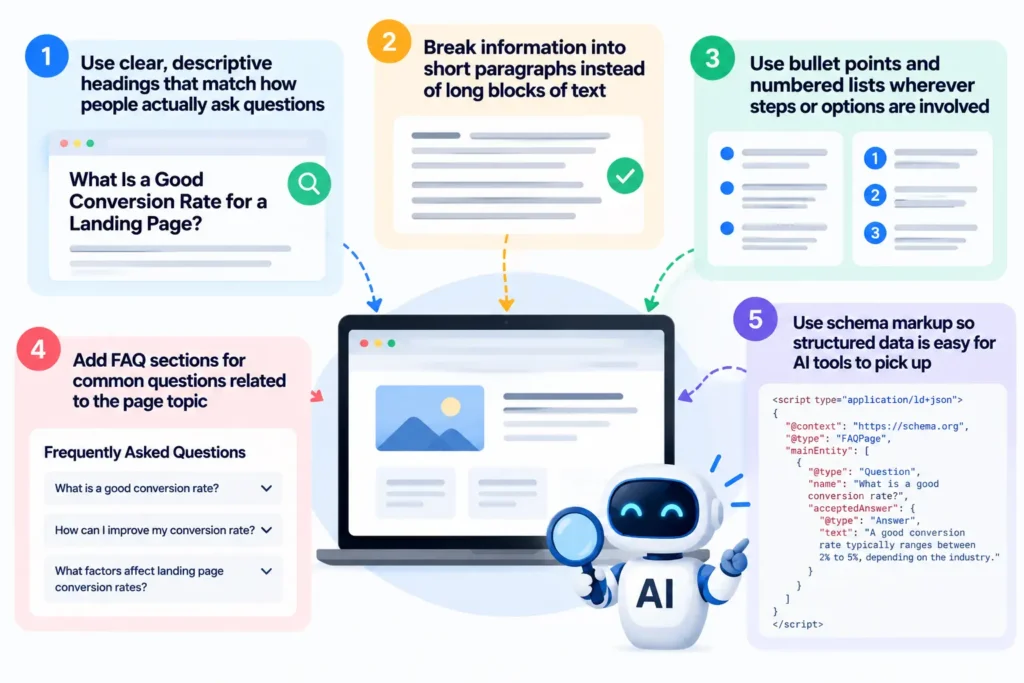
- Use clear, descriptive headings that match how people actually ask questions
- Break information into short paragraphs instead of long blocks of text
- Use bullet points and numbered lists wherever steps or options are involved
- Add FAQ sections for common questions related to the page topic
- Use schema markup so structured data is easy for AI tools to pick up
None of this requires a complete rebuild of your site. Most of the time it’s a matter of reformatting existing content so it’s easier to scan, both for people and for the tools summarizing it on their behalf.
Back up what you say with real credibility
AI tools are cautious about quoting sources that seem vague or unverifiable. Pages that clearly state who wrote them, cite real data, and avoid overly broad claims tend to get treated as more trustworthy. If your content already has author bios, original data, or case studies, make sure that information is easy to find rather than buried somewhere visitors never scroll to.
Keep an eye on how you’re actually showing up
It’s worth checking every so often whether your brand or content shows up when you ask AI tools questions related to your industry. This isn’t something you can fully control, but noticing patterns, like which competitors keep getting mentioned and which of your pages never come up, gives you a much better sense of where the gaps actually are.
When it makes sense to get outside support
Optimizing for AI search touches technical SEO, content structure, and ongoing monitoring all at once, and keeping up with all three while running a business isn’t easy. If this is starting to feel like more than you can track on your own, that’s usually a sign to bring in people who do this full time. Our
Professional SEO services cover both the technical groundwork and the content side, so your site is set up to perform well in traditional search and the newer AI driven search tools at the same time.
The bottom line
Optimizing for AI search isn’t a separate skill you need to learn from scratch. It’s an extension of good SEO, with more weight placed on clarity, structure, and trust. Fix the technical basics first, write answers that get to the point, structure your pages so they’re easy to break down, and keep checking how your site actually shows up. Do that consistently, and you’ll be in a solid position no matter how people choose to search.
Leave a Reply